• Skip to primary navigation
  • Skip to main content
K Brown Auto Repairs

K Brown Auto Repairs

Call 01553 763763 or 01485 533786

Book Here
KING’S LYNN
01553 763763
HUNSTANTON
01485 533786
  • About Us
    • Testimonials
  • What we do
    • Servicing
    • MOT’S
    • Diagnostics
    • Tyres
    • 4-Wheel Alignment
    • Air Conditioning
    • Repairs
    • Electric Cars
    • Free Summer Health Check
  • Pricing
  • Blog
  • Careers
  • Contact Us
  • Request a Quote

Abigail

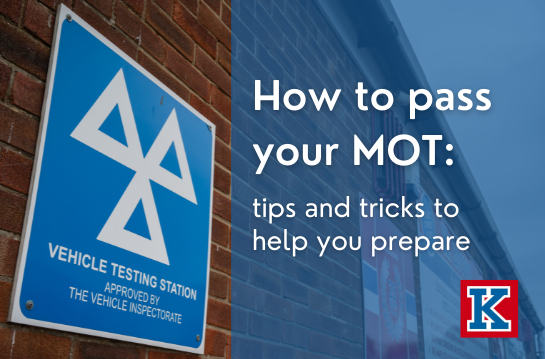
How to pass your MOT: tips and tricks to help you prepare

April 21, 2022

Text reads: How to pass your MOT: tips and tricks to help you prepare

If your car is more than three years old, an annual MOT test is non-negotiable – in fact, it’s a legal requirement to ensure your car is roadworthy. A car with an expired or failed MOT is illegal to drive and could land you with a hefty fine, and even a driving ban. 

It is estimated that around 40% of cars submitted for an MOT check fail the test. Here are some quick checks you can do to improve your chances.

Exterior checks

Tyres and wheels

  • Your tyres should be the right shape and size and be your standard wheel, not a spare.
  • Their tread depth should be a minimum of 1.6mm across the central three-quarter of the pattern. An easy way to measure your tyres’ tread depth is with a 20p coin. We walk you through how to do this in our article ‘3 steps to check your tyres like a pro’.
  • Identify any lumps or cuts? Damage like this could result in your car being deemed unfit for use.

Lights

  • Lights must be fitted with the correct bulbs – that means no crazy colours! 
  • Ask a friend to help you with this next bit. One of you needs to walk around the car, while the other tries all the lights. The person outside should note any flickering or dim lights, as these will need to be fixed or replaced for the car to pass its MOT.

Wipers and windscreen

  • Ensure your wipers and washer fluid are sufficient to clean the windscreen – the driver must always have a good view of the road.
  • If not, replace the wipers, top up your washer fluid, or unblock the jets – whatever is causing the problem. 
  • Any chips or cracks on the windscreen? If they’re bigger than a 5p coin, consider getting this repaired before your test.

Registration plates

  • This should be fastened securely to your car and clean so it can be read easily.
  • If your number plate uses a unique font, check the government website to ensure it meets the requirements.

Doors

  • Check that all doors close and stay closed and that the front doors open from the inside and out.

Vehicle structure

  • Check for sharp edges, loose parts, and excessive damage, i.e. rusting or corrosion, as this could cause your car to fail.

Under the bonnet

  • Top up your brake fluid and fuel if you need to. The garage will need these to carry out an emission test.
  • Check your oil levels and top up if necessary.

Interior checks

Warning lights

  • Turn your car on and check that all your warning lights come on and then off. If a warning light stays on, this could affect your MOT test result. 
  • Make sure the speedometer is working as it should.

Seats

  • These should be locked in position at all times. 

Seatbelts

  • Check for frays or damage as, if present, your seatbelts will not pass.
  • Make sure they’re secured and that they click in and out effectively.

Horn

  • Give your horn a quick toot to make sure it’s working.

Mirrors

  • Clean your mirrors if they’re dirty and position them correctly.
  • Your car must have an interior rear-view mirror and driver’s side mirror to pass.

There are other checks that a technician will conduct during the MOT that are not so easy to do yourself beforehand. This list is not exhaustive, but it does help you prepare your car at least somewhat for its MOT test.

Is your MOT expiring soon?

If the deadline for your MOT test is coming up you’ll want to get your car booked in for a test ASAP. Try our online booking system if you’re tight for time. Or, if you fancy a chat, call either of our friendly reception teams on 01485 533786 for Hunstanton or 01553 763763 for King’s Lynn.

Book your MOT online

Cam belts: their function and why not looking after them could negatively impact your car and your bank balance

February 25, 2022

Text reads: everything you need to know about cam belts

However unassuming the cam belt may seem, it plays a crucial role in keeping your car safe on the road. If not properly maintained, it could cause serious damage to your engine.

What is a cam belt? 

Simply put, it’s a vital piece of the engine. Its job is to control the timing of your vehicle’s internal combustion engines. It’s also sometimes referred to as a timing belt.

Does your car have one? 

Some cars don’t actually have a cam belt and have a cam chain instead, for example, most BMW and Mercedes cars. Check your vehicle handbook or speak to your garage to find out if you have a cam belt or cam chain.

What’s the difference between a cam belt and a cam chain?

The main difference is the material. Cam chains are made of metal, housed inside the engine and lubricated by the engine oil. Whereas cam belts are usually outside the engine, however, some manufacturers are now using “wet belts” which run internally in the engine oil like cam chains. Cam chains can last longer than cam belts because they’re made of stronger material.

When do you need to replace a cam belt? 

This differs depending on the make and model of your car; your best bet is to check the manufacturer’s specifications, which will set out the necessary service intervals. These intervals can either be time-related or by the number of miles the vehicle has done (whatever comes first).

It’s so important that you follow the manufacturer’s requirements and get your cam belt replaced when it needs to be as the risks of not doing so can be both costly and dangerous. It will cost you much less if you honour the recommended service intervals and get it replaced on time, then if you wait till it’s at breaking point – or breaks completely. If you don’t look after your cam belt, it can perish, damaging your engine. Take extra care if your car stops and starts a lot (if you take your car out on a lot of short journeys) or if you rarely use your car as this can cause the cam belt to disintegrate quicker.

Things you need to know: 

  • Ensure you use a qualified technician to fit a new cam belt. As long as you take your car to a reputable garage, you should be fine. 
  • Is the technician doing the job cam belt insured? If something goes wrong and they’re not, you may end up paying much more than you expected.
  • A lot of cars nowadays require specialist tools to carry out a cam belt replacement. The technician doing your cam belt should have access to and be competent in using these tools. 
  • DON’T FORGET a poorly maintained cam belt could destroy your engine.

Find out more

We have garages in King’s Lynn and Hunstanton and offer trustworthy vehicle maintenance done by qualified technicians and friendly customer service.

More about us

E10 petrol explained: how will the new fuel affect your car, and is it even eco-friendly?

February 2, 2022

E10 petrol switch explained

In Summer 2021, the UK made the switch to E10 as the standard petrol grade – as opposed to E5 – in a bid to cut carbon dioxide emissions. Formula 1 is now also committing to this change; as of next season all race cars will run on E10 fuel. Ferrari has complained of having to redesign the internal combustion engine of its vehicles to ensure the new fuel doesn’t negatively impact their performance on the track. But, what does the introduction of E10 really mean for us and our ‘ordinary’ vehicles?

If you’re not already clued up, E10 motor fuel contains less carbon and more ethanol (a kind of alcohol manufactured from plants) than other fuels. The idea is that E10 will help reduce the overall quantity of fossil fuel’s needed to power cars in the UK. Previously, the petrol grades in the UK were all known as E5, as they contained up to 5% ethanol, with the other 95% being regular unleaded petrol. Which means – you’ve guessed it – E10 contains 10% ethanol instead.

There is much debate as to whether E10 is damaging vehicles or not; many complain of a reduction in power meaning the car has to work harder, increasing overall fuel consumption. However, the government claims that this new, more eco-friendly fuel should be safe for every petrol vehicle built after 2011. Those with older vehicles should avoid it and use the old E5, which is still on sale in the super grade at most petrol stations. If you’re unsure visit https://check-vehicle-compatibility-e10-petrol.service.gov.uk/, a site set up by the government where you can check whether your car will run on E10 fuel. Be careful though, as the government will not be liable for any damage to your vehicle as a result of using its checker, especially if you have had replacement parts fitted. If you accidentally put E10 fuel in a vehicle that isn’t compatible, don’t panic as it will still run, according to the RAC. Over time though, it could cause damage to rubber seals, plastics and metals.

So, the big question; how environmentally friendly is E10 really? Of course, there is no straight answer. Despite the fact that ethanol is seen a carbon-neutral (the plants absorb carbon dioxide from the air while they are growing, offsetting the CO2 emitted when the fuel is burnt), sceptics are debating whether this is really the case. Some are even questioning using food crops to produce fuels from a moral standpoint, worrying that it may cause food shortages or an increase in food prices. It is yet to be determined whether this change is for the better or not – if it is genuinely good for the planet, drivers may just have to ‘suck it up’ and deal with the blow to their car’s performance.

Find out more

We have garages in Hunstanton and King’s Lynn and offer a range of servicing options, MOTs, general repairs and more.

About us

Common car maintenance myths debunked

January 10, 2022

Common car maintenance myths debunked main image for blog post

As with most industries, the car world has its own version of Chinese whispers. Unfortunately, it’s often hard to determine what’s true and what’s false. Follow the wrong advice and you could suffer real-life consequences. 

So, what are some of the most common car maintenance myths?

Premium fuel is better for your car and will improve its performance

This myth can be both true and false, depending on the car you drive. The cheaper petrol fuel has to meet quality standards, so won’t actually harm your vehicle’s engine; however, if you have a car with a big engine, the premium option is best as it can make for a smoother and potentially even faster drive. If you drive a car with an average-sized engine, choosing premium fuel will cost you more without the added benefits – it makes absolutely no difference to the cars’ performance in this case.

Roll down the windows instead of using the air conditioner for better fuel economy

Some people believe that rolling down the windows is better than blasting the air conditioning to keep your car cool. It’s thought that this reduces the amount of fuel consumed, however it actually makes little difference to fuel efficiency.

You need to change your oil every 3,000 miles

Although this used to be the case, nowadays how often you need to change your oil depends on the manufacturer. Schedule your oil changes based on your owner’s manual recommendations – otherwise you might as well pour your money down the drain. 

Vehicle servicing at independent repair shops will void your warranty

Many people assume that you should have your car serviced at the dealership while it’s under warranty, and that going elsewhere will void it. It’s in the dealerships best interest to make people believe this; however, it’s not true. Any VAT registered garage can work on cars under warranty – just save your receipts to prove what was done and how much it cost. As long as the garage you go to sticks to the maintenance specified in the owner’s manual and does it at the correct times, your warranty will stay intact.

There are lots of motoring myths out there, some harmless, others that could cause serious damage to your car. Hopefully the above will save you some grief!

5 Ways to Get Your Car Ready for Winter

December 3, 2021

5 ways to get your car ready for winter

It may be referred to as the most wonderful time of the year, but, for unprepared drivers, it can quickly turn into the most dangerous. Now, we don’t want to put a dampener on the festivities, but believe us when we say nothing could ruin this season more than getting a flat battery on the way to stuff your face with Christmas dinner. 

Here are five things you can do to get your car ready for winter:

1) Check your battery

Your battery suffers from cold temperatures and the increased use of your lights, heater and blower at this time of year, putting it under extra pressure. If it’s already in need of some TLC, you may find yourself stuck on the side of the road with a car that won’t start – not to mention how cold you would be!

2) Top up your engine coolant with antifreeze

Although this may seem like a simple job, there’s still a right and wrong way to do it. For example, if you’ve previously topped up your coolant with water, any antifreeze added later would be over-diluted and be prone to freezing. To avoid any problems, it’s best to take your car to a garage who can do it for you. 

3) Inspect your tyres

When it starts to feel like the North-Pole outside the roads can turn icy, making them particularly perilous. Make sure your tyres are ready to tackle this by checking their pressure and tread depth. We recommend a minimum tread depth of 3mm.

4) Get ready for icy mornings

If you haven’t allocated yourself enough time before work in the morning to de-ice your car, you may feel compelled to drive off without finishing the job, despite your sight being compromised. Obviously, this is incredibly risky, so it’s important that you’re prepared for this scenario; you should always have a good scraper (if not, something similar like a spatula or credit card can work too) and a De-Icer product in your car. 

5) Book in for a winter car service

If your car is due a service, get it done before the temperature plummets. A mechanic will look at your tyres, battery, coolant and antifreeze, windscreen wipers, lights and oil. Getting everything checked and any work done by a professional prior to the cold weather will give you peace of mind that you’re as safe on the road as you can be this winter.

Book your free winter check

We offer a free winter check and our services start from £95. Contact us to book or for more information.

Contact Us
  • « Go to Previous Page
  • Page 1
  • Page 2
  • Page 3
  • Page 4
  • Page 5
  • Page 6
  • Page 7
  • Go to Next Page »

K Brown Auto Repairs

  • Facebook
  • Instagram
Auto Repairs
  • Privacy Policy
  • Website By Business Equip
We use cookies on our website to give you the most relevant experience by remembering your preferences and repeat visits. By clicking “Accept All”, you consent to the use of ALL the cookies. However, you may visit "Cookie Settings" to provide a controlled consent.
Cookie SettingsAccept All
Manage consent

Privacy Overview

This website uses cookies to improve your experience while you navigate through the website. Out of these, the cookies that are categorized as necessary are stored on your browser as they are essential for the working of basic functionalities of the website. We also use third-party cookies that help us analyze and understand how you use this website. These cookies will be stored in your browser only with your consent. You also have the option to opt-out of these cookies. But opting out of some of these cookies may affect your browsing experience.
Necessary
Always Enabled
Necessary cookies are absolutely essential for the website to function properly. These cookies ensure basic functionalities and security features of the website, anonymously.
CookieDurationDescription
cookielawinfo-checkbox-analytics11 monthsThis cookie is set by GDPR Cookie Consent plugin. The cookie is used to store the user consent for the cookies in the category "Analytics".
cookielawinfo-checkbox-functional11 monthsThe cookie is set by GDPR cookie consent to record the user consent for the cookies in the category "Functional".
cookielawinfo-checkbox-necessary11 monthsThis cookie is set by GDPR Cookie Consent plugin. The cookies is used to store the user consent for the cookies in the category "Necessary".
cookielawinfo-checkbox-others11 monthsThis cookie is set by GDPR Cookie Consent plugin. The cookie is used to store the user consent for the cookies in the category "Other.
cookielawinfo-checkbox-performance11 monthsThis cookie is set by GDPR Cookie Consent plugin. The cookie is used to store the user consent for the cookies in the category "Performance".
viewed_cookie_policy11 monthsThe cookie is set by the GDPR Cookie Consent plugin and is used to store whether or not user has consented to the use of cookies. It does not store any personal data.
Functional
Functional cookies help to perform certain functionalities like sharing the content of the website on social media platforms, collect feedbacks, and other third-party features.
Performance
Performance cookies are used to understand and analyze the key performance indexes of the website which helps in delivering a better user experience for the visitors.
Analytics
Analytical cookies are used to understand how visitors interact with the website. These cookies help provide information on metrics the number of visitors, bounce rate, traffic source, etc.
Advertisement
Advertisement cookies are used to provide visitors with relevant ads and marketing campaigns. These cookies track visitors across websites and collect information to provide customized ads.
Others
Other uncategorized cookies are those that are being analyzed and have not been classified into a category as yet.
SAVE & ACCEPT