• Skip to primary navigation
  • Skip to main content
K Brown Auto Repairs

K Brown Auto Repairs

Call 01553 763763 or 01485 533786

Book Here
KING’S LYNN
01553 763763
HUNSTANTON
01485 533786
  • About Us
    • Testimonials
  • What we do
    • Servicing
      • Land Rover and Jaguar Servicing in King’s Lynn
    • MOT’S
    • Diagnostics
    • Tyres
    • 4-Wheel Alignment
    • Air Conditioning
    • Repairs
    • Electric Cars
    • Free Summer Health Check
  • Pricing
  • Blog
  • Careers
  • Contact Us
  • Request a Quote

Uncategorized

Why Do Garages Charge for Diagnostics? What You’re Really Paying For

September 10, 2026

When a warning light appears on your dashboard, your car starts making an unusual noise, or something simply doesn’t feel right, it can be tempting to assume you already know what the problem is.

You might have Googled the symptoms, had a friend take a look, used a code reader at home, or even been told by another garage what they think needs replacing.

So, when we tell you that we need to carry out diagnostics before we can recommend a repair, a perfectly reasonable question is:

“Why do I need to pay for diagnostics when I already know what the problem is?”

At K Brown Auto Repairs, diagnostics aren’t about adding an unnecessary charge to your bill. They’re about making sure we understand why your vehicle has developed a fault before we start spending your money trying to fix it.

And there’s a lot more involved than simply plugging a computer into your car.

A Fault Code Isn’t a Diagnosis

This is probably one of the biggest misconceptions surrounding vehicle diagnostics.

Modern vehicles contain numerous electronic control units and sensors that constantly monitor different systems. When the vehicle detects something outside its expected parameters, it may store a fault code.

Diagnostic equipment allows our technicians to access this information, but that fault code is usually only the starting point.

For example, a fault code relating to a particular sensor doesn’t necessarily mean:

“Replace this sensor.”

It could be caused by the sensor itself, but it could also be a wiring problem, poor connection, mechanical issue, incorrect reading elsewhere in the system or another component causing that sensor to report something unexpected.

Simply replacing the component mentioned in a fault code can become an expensive guessing game.

Proper diagnostics asks a different question:

“What is actually causing this fault?“

So, What Are You Paying for When You Pay for Diagnostics?

When we charge for diagnostic work, you’re not simply paying for the few minutes it takes to connect a diagnostic machine.

The cost helps cover an entire diagnostic process.

1. A Skilled Technician’s Time

Good diagnostic work requires knowledge, experience and logical problem-solving.

Our technicians need to understand how the vehicle’s different systems operate, interpret the information they’re receiving and decide which tests need to be carried out next.

Depending on the fault, this can involve inspecting components, checking wiring, testing electrical circuits, analysing live vehicle data, taking measurements and comparing results against manufacturer specifications.

You’re paying for the technician’s ability to interpret the evidence—not simply access it.

2. Professional Diagnostic Equipment

Modern vehicle diagnostic equipment is sophisticated and expensive.

Independent garages like ours continually invest in professional equipment that allows our technicians to communicate with increasingly complex vehicle systems.

But purchasing the equipment is only part of the cost.

There are also software licences, subscriptions and regular updates required to keep that equipment useful as manufacturers release new vehicles, systems and technology.

A basic code reader and professional diagnostic equipment are very different things.

3. Technical Information

Diagnosing a vehicle properly often requires access to manufacturer-level technical information.

This can include wiring diagrams, testing procedures, technical specifications, component locations and known fault information.

Access to reliable technical data helps us test a vehicle systematically rather than relying on guesswork – and it isn’t free!

4. Training and Experience

Cars have changed enormously over the years.

Modern vehicles combine mechanical systems with increasingly complicated electronics, computers, sensors, communication networks and software. Hybrid and electric vehicles introduce even more specialist technology.

Our technicians therefore need ongoing training to keep their knowledge current.

When you’re paying for diagnostics, part of what you’re paying for is the expertise that allows someone to take a collection of symptoms, fault codes and test results and turn them into an accurate diagnosis.

5. The Time It Takes to Find the Actual Cause

Some faults can be identified relatively quickly.

Others can’t.

An intermittent electrical fault, for example, may require considerably more investigation than a straightforward component failure.

This is why diagnostic work isn’t always something we can accurately predict down to the minute before we’ve started investigating.

The important thing is that the time is being spent finding evidence and narrowing down the cause of the problem, rather than replacing parts and hoping for the best.

“But I Already Know What’s Wrong With It”

We hear this fairly regularly, and sometimes the customer’s initial suspicion turns out to be absolutely correct.

But before we recommend a repair, we need to be confident that we’re fixing the cause of the problem.

Imagine you’re convinced a particular component has failed and ask us to replace it.

We could simply fit the part.

But what happens if that doesn’t fix the problem?

You’ve now paid for a component you may not have needed, the original fault is still present and further investigation is required anyway.

That’s not an outcome we want for our customers.

We would much rather spend time establishing what’s actually wrong first and then recommend the appropriate repair.

Diagnosis before repair helps protect your money.

“Why Can’t You Just Plug It In and Tell Me What’s Wrong?”

Unfortunately, diagnostic machines aren’t magic boxes that tell technicians exactly which part to replace.

They provide information.

It’s the technician who has to understand what that information means.

Think of a diagnostic scan a little like a clue in an investigation. It helps point us in the right direction, but further testing may be needed before we can confidently identify the culprit.

That’s the difference between reading fault codes and diagnosing a fault.

Why Diagnostics Can Actually Save You Money

Paying for diagnostic time before paying for a repair can sometimes feel counterintuitive.

Surely it would be cheaper just to replace the most likely part?

Sometimes it might be. But when that guess is wrong, costs can quickly mount up.

You could replace one component, discover the fault is still there, replace another, and eventually end up paying for diagnostics anyway.

A structured diagnostic process is designed to reduce unnecessary parts replacement and get to the root cause of the problem.

We can’t promise that every fault will be simple or inexpensive to repair. What we can do is approach the problem methodically and make recommendations based on evidence.

Why We Don’t Want to Guess With Your Car

At K Brown Auto Repairs, we’re very conscious that vehicle repairs cost money.

That’s exactly why we don’t believe guessing is good enough.

If we’re going to recommend that you spend your money replacing a component or carrying out a repair, we want a sound technical reason for making that recommendation.

Sometimes that means spending time testing before we can give you an answer.

And sometimes the diagnostic process may uncover something completely different from what you—or even we—initially suspected.

That’s the purpose of diagnostics.

Not to prove that we were right at the beginning, but to find out what’s actually wrong.

What Happens If Diagnostics Takes Longer Than Expected?

Not every vehicle fault fits neatly into a set amount of diagnostic time.

Some problems reveal themselves quickly, while others require further investigation.

If additional diagnostic work is required, we’ll explain what we’ve found so far and what we recommend doing next. We don’t want diagnostic work to become an open-ended bill without communication.

Sometimes the honest answer after an initial investigation is:

“We’ve ruled some things out, but we need more time to find the cause.”

That may not be as satisfying as an instant answer, but we’d rather be transparent than pretend we know something we haven’t yet proven.

Modern Cars Require Modern Diagnostics

Vehicles are becoming more sophisticated every year.

Even systems that once seemed relatively simple can now involve sensors, control modules and electronic communication between different parts of the vehicle.

That means proper diagnostic capability isn’t an optional extra for a modern workshop.

It’s an essential part of repairing vehicles safely and correctly.

At K Brown Auto Repairs, we invest in the equipment, technical information and training our team needs because we believe our customers deserve more than trial and error.

You’re Paying for an Answer, Not Just a Plug-In

Ultimately, when you pay for professional diagnostics, you’re paying for much more than connecting a computer to your vehicle.

You’re paying for:

  • A trained technician’s time and expertise
  • Professional diagnostic equipment
  • Software, licences and updates
  • Access to technical information and wiring diagrams
  • Testing and measurement equipment
  • Ongoing technician training
  • A logical, evidence-based investigation
  • The confidence that we’re trying to identify the cause before recommending a repair

We understand why diagnostic charges can sometimes be frustrating—particularly when you already have a good idea of what’s wrong.

But our aim isn’t to make repairing your vehicle more expensive.

It’s to avoid unnecessary repairs, reduce guesswork and make sure that when we ask you to spend money fixing your vehicle, we’re making that recommendation for the right reasons.

Because replacing parts is easy. Knowing which part actually needs replacing—and why—is where professional diagnostics really earns its value.

Need Help With a Warning Light or Vehicle Fault?

If your vehicle has developed a warning light, electrical problem, running issue or another fault that needs investigating, our team at K Brown Auto Repairs can help.

With experienced technicians, professional diagnostic equipment and workshops in King’s Lynn and Hunstanton, we’ll work methodically to identify the cause of the problem and explain what we find before recommending the next steps.

Book in for Diagnostics

Speak to our team in Hunstanton or King’s Lynn for help identifying a fault with your vehicle today.

Contact Us

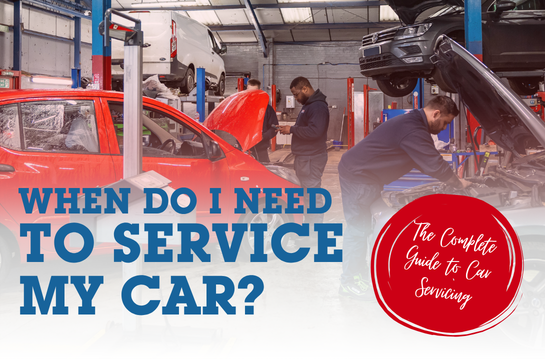
When Do I Need to Service My Car? The Complete Guide to Car Servicing

August 5, 2026

Wondering when do I need to service my car?

It’s one of the most common questions we hear at K Brown Auto Repairs—and it’s an important one.

Whether you drive 5,000 or 25,000 miles a year, keeping your vehicle serviced is one of the best investments you can make. Regular servicing improves reliability, helps prevent costly repairs, keeps your car running efficiently and, most importantly, helps keep you and your family safe.

Many motorists only think about booking a service when a warning light appears or something starts making a strange noise. Unfortunately, by then, what could have been a relatively inexpensive repair may already have developed into a much bigger problem.

In this guide, we’ll answer the questions:

  • When do I need to service my car?
  • How often should you service a car?
  • When do cars need servicing?
  • When is my car service due?
  • When should you service your car?

We’ll also explain why servicing matters, what’s included, how service intervals are determined and why choosing the right garage makes all the difference.

Quick Answer: When Do I Need to Service My Car?

For most vehicles, the recommended service interval is:

  • Every 12 months, or
  • Every 10,000–12,000 miles

whichever comes first.

However, this isn’t a rule that applies to every vehicle.

Every manufacturer designs their engines differently, and many modern vehicles use flexible servicing schedules that monitor how the vehicle is driven before calculating when a service is required.

The best answer to “when do I need to service my car?” is to follow your manufacturer’s recommendations—but if you’re unsure, we can check your vehicle’s service schedule for you.

How Often Should You Service a Car?

Many people search “how often to service a car” because they’re unsure whether mileage or time is more important.

The answer is both.

Even if you rarely drive your vehicle, engine oil naturally degrades over time. Moisture builds up, additives break down and lubrication becomes less effective.

Likewise, if you drive high annual mileage, components wear more quickly and require more frequent maintenance.

That’s why manufacturers specify both:

  • Maximum mileage
  • Maximum time interval

Whichever comes first determines when your next service is due.

How Can I Know When My Car Service is Due?

If you’re wondering “when is my car service due?”, there are several ways to find out.

Check Your Dashboard

Many modern vehicles display a service countdown or reminder message.

These systems calculate service intervals using information such as:

  • Mileage
  • Engine running time
  • Driving style
  • Temperature
  • Fuel consumption

If your dashboard says your service is due soon, don’t ignore it.

Check Your Service Book

Your vehicle’s service history will show:

  • Date of previous service
  • Mileage completed

If you’re close to either the mileage or annual deadline, it’s time to book your vehicle in.

Ask K Brown Auto Repairs

Not sure what your vehicle needs?

Our service team can identify your manufacturer’s recommended servicing schedule and advise exactly when your next service should be completed.

A Deeper Dive into What Determines When Your Service is Due

Manufacturer Recommendations

Every vehicle is different.

A small petrol hatchback has different maintenance requirements from a diesel SUV, hybrid or electric vehicle.

Manufacturers spend years testing their vehicles and create servicing schedules designed to maximise reliability and longevity.

These intervals should always be your starting point.

Your Driving Style

The way you drive has a huge impact on servicing.

You may need more frequent servicing if you:

  • Regularly drive short journeys
  • Sit in heavy traffic every day
  • Tow caravans or trailers
  • Carry heavy equipment
  • Drive in rural or dusty conditions
  • Frequently drive at motorway speeds

These conditions place additional stress on the engine, brakes and other mechanical components.

Vehicle Age

Older vehicles often benefit from more regular inspections.

Rubber components naturally deteriorate with age, fluids become contaminated and wear becomes more common.

A regular servicing routine helps catch issues before they become expensive repairs.

Why Is Regular Servicing So Important?

Servicing is preventative maintenance.

Instead of waiting for something to break, technicians inspect and replace components before failure occurs.

This helps:

  • Reduce breakdowns
  • Improve reliability
  • Increase fuel economy
  • Protect engine life
  • Maintain resale value
  • Improve safety
  • Reduce unexpected repair bills

In many cases, routine servicing saves significantly more money than it costs.

What Happens During a Car Service?

Many people assume a service simply means changing the oil.

In reality, a professional vehicle service is far more comprehensive.

Depending on the service level, technicians inspect or replace:

Engine Oil

Fresh oil lubricates moving engine components and prevents premature wear.

Old oil becomes contaminated and loses its protective properties.

Oil Filter

The oil filter removes contaminants from engine oil.

A blocked filter reduces lubrication and increases engine wear.

Air Filter

A clean air filter helps the engine breathe efficiently, improving both performance and fuel economy.

Cabin Filter

This keeps dust, pollen and pollutants out of the passenger compartment.

Fuel Filter

Where fitted, this prevents contaminants entering the fuel system.

Spark Plugs

On petrol vehicles, spark plugs are an essential part of the ignition system.

Brakes

Your technician will inspect:

  • Brake pads
  • Brake discs
  • Brake fluid
  • Brake pipes
  • Brake operation

Brakes are one of the most important safety systems on your vehicle.

Brake Fluid Change

The brake fluid is changed at certain intervals, usually every two years.

Suspension

Suspension components affect handling, tyre wear and ride comfort.

Worn suspension parts can reduce vehicle stability.

Steering

Steering joints and components are checked for wear or excessive movement.

Battery

Battery condition is tested to reduce the risk of unexpected starting problems.

Cooling System

Coolant levels and condition are checked to help prevent overheating.

Tyres

Technicians inspect:

  • Tread depth
  • Tyre pressures
  • Uneven wear
  • Damage

Properly maintained tyres improve grip, safety and fuel economy.

Exhaust

The exhaust system is visually inspected for signs of leaks, corrosion, damage or insecure mountings.

Lights

All bulbs are checked to ensure your vehicle remains safe and legal.

What Happens If You Don’t Service Your Car?

Skipping servicing often creates much bigger problems later.

Without regular maintenance:

  • Engine oil deteriorates.
  • Moving components wear faster.
  • Filters become blocked.
  • Fuel economy worsens.
  • Minor faults become expensive repairs.
  • Reliability decreases.
  • Breakdown risk increases.

We’ve seen many cases where relatively inexpensive maintenance could have prevented repairs costing thousands of pounds.

Does an MOT Replace a Service?

No.

This is one of the biggest misconceptions among motorists.

An MOT is a legal roadworthiness inspection.

A service is preventative maintenance.

An MOT checks whether your vehicle meets minimum legal safety standards on that particular day.

It does not include replacing engine oil, servicing filters or carrying out preventative maintenance.

Your vehicle should still be serviced even if it passes its MOT.

Signs Your Car May Need Servicing

Even if your service interval hasn’t arrived, your vehicle may be telling you it needs attention.

Common signs include:

  • Service reminder light
  • Reduced fuel economy
  • Poor performance
  • Excessive engine noise
  • Vibrations
  • Difficulty starting
  • Smoke from the exhaust
  • Fluid leaks
  • Warning lights

If you notice any of these symptoms, it’s worth having your vehicle inspected sooner rather than later.

Can Missing a Service Void My Warranty?

Potentially.

Many manufacturers require servicing to be completed according to their maintenance schedule.

Missing services could affect warranty claims if a fault develops.

The good news is that your vehicle doesn’t necessarily have to be serviced by a main dealer.

A qualified independent garage like us can service most vehicles to manufacturer specifications while protecting your warranty, using approved servicing procedures and quality parts.

How Often Should Hybrid and Electric Vehicles Be Serviced?

Hybrid and electric vehicles still require regular servicing.

Although they have fewer moving engine components than traditional petrol or diesel vehicles, they still need maintenance including:

  • Brakes
  • Suspension
  • Steering
  • Cabin filters
  • Coolant (where applicable)
  • Tyres
  • Battery health inspections
  • High-voltage safety checks

Our technicians are trained to work safely on hybrid and electric vehicles using specialist diagnostic equipment.

Is Annual Servicing Worth It?

Absolutely.

Even low-mileage vehicles benefit from annual servicing.

Many expensive repairs begin simply because maintenance has been delayed.

Why Choose K Brown Auto Repairs?

We believe servicing should be about far more than ticking a box.

As a family-run independent garage, we’ve built our reputation on quality workmanship, honest advice and exceptional customer care.

Our customers choose us because we offer:

  • Highly skilled technicians
  • Advanced dealer-level diagnostic equipment
  • Manufacturer-recommended servicing procedures
  • Genuine or OEM-quality parts
  • Honest advice with no unnecessary repairs
  • Friendly, personal service
  • Clear communication throughout every visit

We’re not the cheapest garage in the area—and we’re proud of that.

Using quality parts, investing in specialist equipment and allowing our technicians the time to carry out work properly means your vehicle receives the care it deserves.

We believe that’s better value than cutting corners.

Book Your Next Service with K Brown Auto Repairs

If you’re searching online for:

  • when do I need to service my car
  • when does a car need a service
  • how often to service a car
  • when do cars need servicing
  • when is my car service due
  • when to service your car

we’re here to help.

Need help with your service?

If you’re unsure what’s due, simply get in touch. We’ll check your vehicle’s service history, explain exactly what it needs and help keep it running safely and reliably for years to come.

Contact Us

Frequently Asked Questions

When do I need to service my car?

Most vehicles require servicing every 12 months or every 10,000–12,000 miles, whichever comes first. Always check your manufacturer’s recommendations.

How often should you service a car?

Generally once a year, although high-mileage vehicles may require more frequent servicing.

When do cars need servicing?

Cars need servicing according to the manufacturer’s maintenance schedule, which considers both time and mileage.

When is my car service due?

Check your dashboard reminder, service book, previous invoice or contact K Brown Auto Repairs and we’ll be happy to advise.

When should you service your car?

You should service your car before the recommended interval is exceeded—not after a problem develops.

Why Choose an Independent Garage? The Smart Choice for Car Owners

July 22, 2026

Why choose an independent garage? The smart choice for car owners

When your car needs servicing or repairs, it’s easy to assume that a main dealership is your only option. However, more and more drivers are discovering the benefits of using an independent garage for everything from routine servicing to complex repairs.

If you’ve ever wondered why choose an independent garage, this guide explains the advantages and answers some of the most common questions motorists ask.

Why Choose an Independent Garage?

There are plenty of reasons why drivers are moving away from expensive dealerships and choosing trusted local garages instead.

Better Value for Money

One of the biggest advantages of an independent garage is cost. Independent garages typically have lower overheads than franchised dealerships, allowing them to offer competitive prices without compromising on the quality of their work.

Whether you need a routine service, MOT, brakes, tyres or diagnostics, you’ll often receive the same high standard of workmanship at a more affordable price.

Personal, Friendly Service

Independent garages build their reputation on customer satisfaction and repeat business. Unlike large dealership networks, you’ll often deal directly with the technicians working on your vehicle.

This means:

  • Honest advice
  • Clear explanations of any repairs needed
  • No unnecessary upselling
  • A more personal customer experience

Many customers continue using the same independent garage for years because they know they can trust the advice they’re given.

Skilled and Experienced Technicians

Today’s independent garages invest heavily in modern diagnostic equipment and ongoing technician training. Many mechanics have previously worked in main dealerships and have years of experience servicing vehicles from all major manufacturers.

Whether you drive a Ford, BMW, Audi, Volkswagen, Toyota or another make, an experienced independent garage can usually provide expert care.

Can an Independent Garage Service My Car?

One of the most common questions drivers ask is:

Can an independent garage service my car?

The answer is yes.

Thanks to legislation introduced to encourage competition in the automotive industry, you are free to choose where your vehicle is serviced.

As long as the garage follows the manufacturer’s service schedule and uses parts and fluids that meet the required specifications, your manufacturer’s warranty is generally unaffected.

Many independent garages use genuine or original-equipment-quality parts and maintain detailed digital service records where applicable, ensuring your vehicle receives the correct maintenance.

This means you can enjoy dealership-quality servicing while often paying significantly less.

Quality Repairs Without the Dealership Price Tag

An independent garage can carry out a wide range of services, including:

  • Manufacturer servicing
  • EV/Hybrid maintenance
  • MOT testing
  • Brake repairs
  • Clutches
  • Suspension repairs
  • Engine diagnostics
  • Air conditioning servicing
  • Tyres and wheel alignment
  • Batteries
  • Exhaust repairs

Many garages also invest in advanced diagnostic technology, enabling them to accurately identify faults on modern vehicles.

Looking for Independent Garages Near Me?

If you’ve searched online for independent garages near me, you’re not alone.

Thousands of motorists are choosing trusted local garages because they offer:

  • Convenient locations
  • Faster booking availability
  • Competitive pricing
  • Friendly customer service
  • Experienced technicians
  • High-quality repairs

Choosing a reputable local garage also helps support independent businesses within your community while giving you access to a team that values long-term customer relationships.

What Makes a Good Independent Garage?

Not all garages are the same, so it’s worth looking for one that offers:

  • Qualified and experienced technicians
  • Transparent pricing
  • Excellent customer reviews
  • Modern diagnostic equipment
  • High-quality replacement parts
  • Clear communication throughout the repair process

A trustworthy independent garage will explain any work required before starting repairs and will always be happy to answer your questions.

The Bottom Line

If you’ve been asking yourself why choose an independent garage, the answer is simple.

An independent garage can provide expert servicing, quality repairs, friendly customer service and excellent value for money—all without the premium prices often associated with main dealerships.

Whether you’re looking for routine maintenance, diagnostics or major repairs, choosing a trusted local garage can save you money while ensuring your vehicle receives professional care.

So, the next time you’re searching for independent garages near me, remember that your local independent garage could offer the expertise, reliability and personal service you’re looking for.

And if you’re still wondering, can an independent garage service my car? The answer is almost certainly yes. With the right equipment, experienced technicians and adherence to manufacturer servicing schedules, an independent garage is often the smart choice for keeping your vehicle safe, reliable and running at its best.

Want to try us out?

Learn more about our servicing, request a quote or book online.

Find Out More

Mobile Mechanic or Independent Garage: Which One is Best?

June 4, 2026

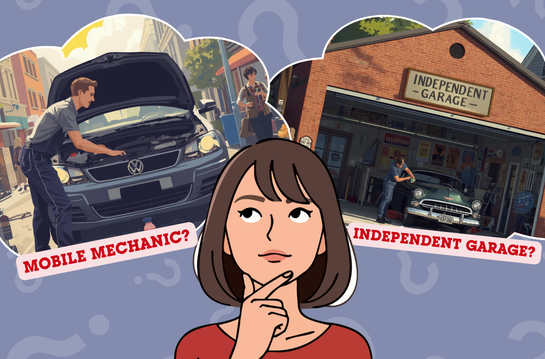
cartoon woman thinking about mobile mechanics and independent garage and trying to choose between them

Vehicle owners are spoilt for choice these days; there are so many main dealerships, independent garages and now we are seeing an influx of mobile mechanics doing business in the area. Understandably, more and more people are considering whether a mobile mechanic is a good fit for their lifestyle and vehicle needs. 

Mobile mechanics are vehicle technicians that come out to your home (and often place of work) and fix your vehicle there and then. They are known for being convenient, sometimes cheaper (it depends – we’ll get into that!), and personable. However, as with everything, there are also drawbacks to using a mobile mechanic; there are obvious limitations on availability, time, the types of jobs they can do, the equipment they have, and, it can be difficult to find one to trust as they are often unregulated.

If you are one of those people wondering if a mobile mechanic is right for you or if you should take your vehicle to your local independent, here are the pros and cons for both. 

Mobile Mechanic

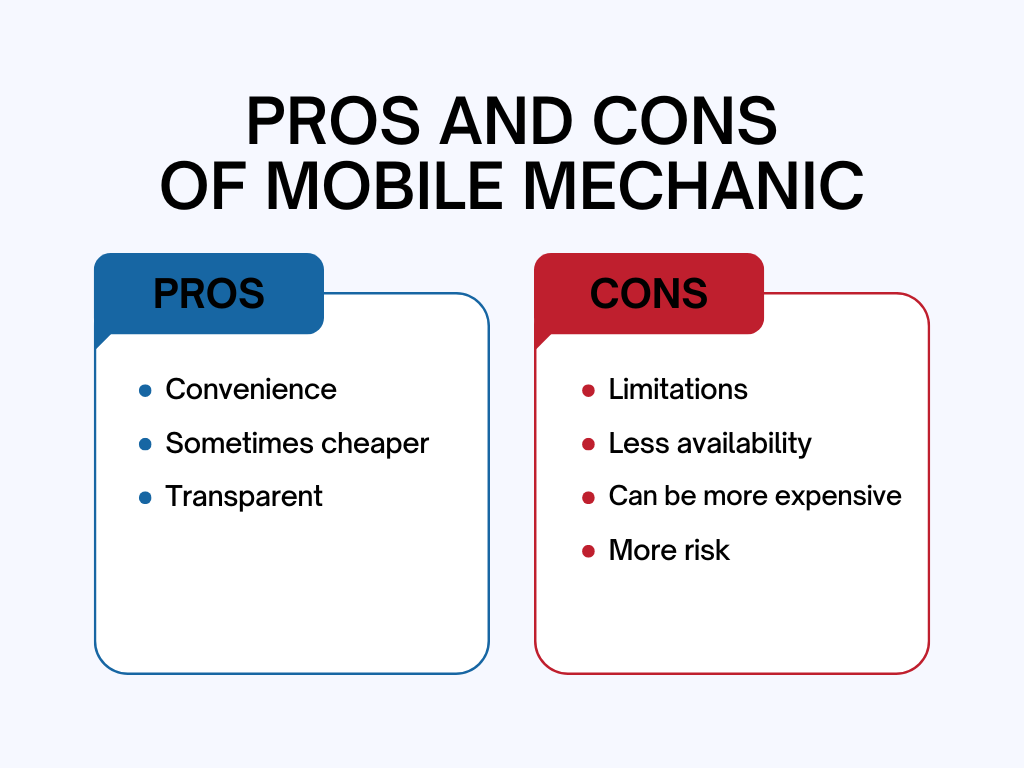
Pros

  • Convenience
    A mobile mechanic comes to you and works on your driveway and sometimes at your place of work if suitable. This can be an invaluable benefit if you have a busy life or can’t leave your car at the garage. It is also ideal if your car is a non-starter or has a fault that deters you from driving it – you don’t have to worry about booking and paying for a recovery.
  • Sometimes cheaper
    Mobile mechanics don’t have as many overheads as garages so they can sometimes charge less for their services. However, it is worth noting that you may have to pay them extra to travel to you depending on their terms and your location. 
  • Transparency
    There is nowhere for a mobile mechanic to hide! This keeps them accountable and ensures you are getting value for money. 

Cons

  • Limitations
    Mobile mechanics are limited to what they can do and when. For example, weather and space will dictate when they can come out to you and they won’t be able to carry certain tools or do certain jobs due to equipment gaps. 
  • Potentially less availability
    Often, mobile techs work alone as it is notoriously difficult to manage staff when you’re on the road. This means they can only work on one vehicle at once, limiting the amount they can book into their diary. You may have to wait a bit longer for a mobile mechanic than you would if you booked into a physical garage. It is also worth noting that, if something goes wrong with a vehicle repair, a mobile mechanic may have to re-organise their diary to fix this, potentially deferring bookings.
  • Can be more expensive
    Depending on the job, it may take mobile mechanics slightly longer to do certain jobs due to not having anyone to help if things get tricky. Garages employ multiple mechanics that can double up on manpower to get jobs done efficiently and collaborate to diagnose complicated faults. Some mobile mechanics may charge travel costs or a higher hourly rate for the convenience.
  • More risk
    If you want to work for yourself, it is significantly quicker and easier to start up as a mobile mechanic than it is to open your own unit. For this reason, there appears to be a plethora of mobile mechanics in operation and, as with all industries, some will be trustworthy and others will not. If you are unlucky and use a mechanic who leaves your vehicle in a worse state than they found it, it may be harder to track them down than if they were at a fixed location. If they avoid your phone calls or emails, there is no other way to approach them.

Independent Garage

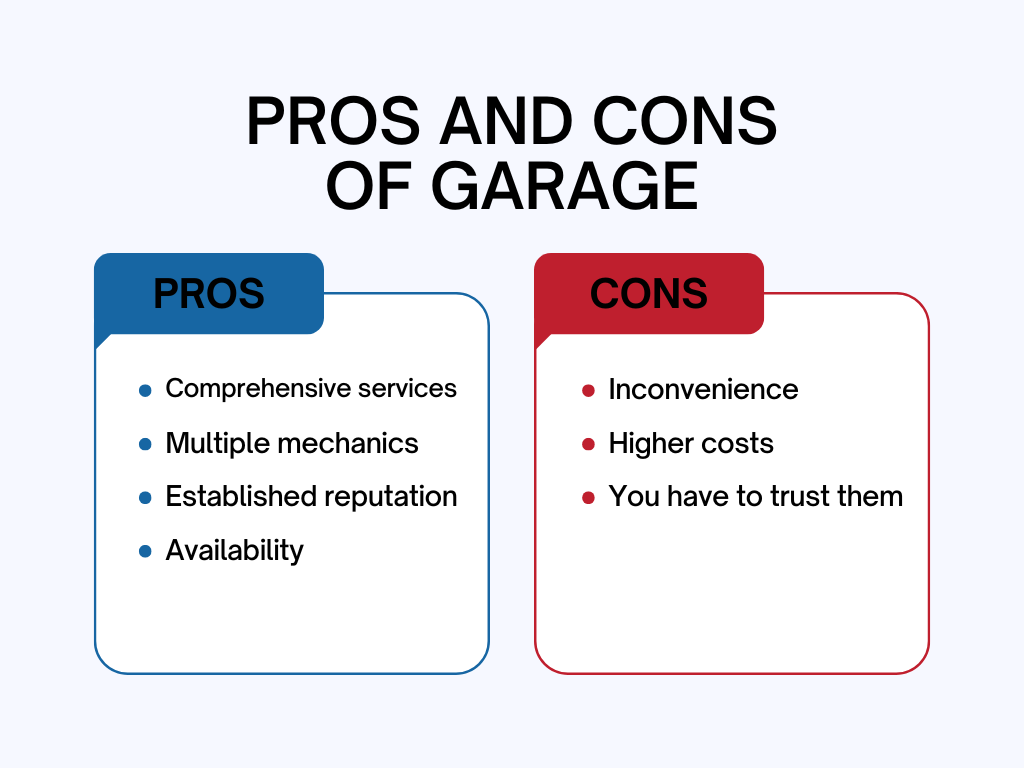
Pros

  • Comprehensive services
    Traditional garages are equipped to handle a wide variety of repairs and maintenance tasks. They often have specialist tools and advanced diagnostic equipment to address complex issues that mobile mechanics are not able to. 
  • Multiple mechanics
    A larger team allows garages to work on different vehicles at once, facilitating quicker turnaround times and more booking availability, especially for more extensive jobs. It also means there is a wider pool of knowledge under one roof – often independent garages have mechanics that are particularly experienced in specific makes and models, which bolsters the understanding and skill level of the workshop as a whole. Vehicles are ever-changing so the ability to collaborate with other technicians can be invaluable to getting to the bottom of a fault and carrying out the right repair.
  • Established reputation
    Many independent garages are well-established and have strong reputations in their local area, offering you peace of mind. A brick-and-mortar garage gives you a physical location to return to if a part fails or a repair requires a follow-up.
  • Availability
    Garages don’t rely on favourable weather to work and have the facilities to work on many vehicles and do many jobs at once. With a team of mechanics and, often a comprehensive service team and booking system, they can have better availability than mobile mechanics. They could also be easier to get hold of – with mobile techs either on the road or fixing a car for most of the working day, they may not be available to answer emails or calls as they come like a fixed location garage with an admin team would. 

Cons

  • Inconvenience
    Taking your vehicle to a garage can be time-consuming and inconvenient. You may need to organise transportation from the garage and, depending on the service, wait times can vary so it can sometimes be hard to fit into your schedule. 
  • Higher costs
    Traditional garages can be more expensive than some mobile mechanics; they have higher overhead costs which can be reflected in the pricing. The expenses to cover maintaining their specialist equipment, physical location, and staff can result in higher fees. 
  • You have to trust them
    Unlike mobile mechanics, it isn’t possible to watch work being done on your vehicle at a traditional garage. This is usually more down to abiding by health and safety rules than being shady (!) but there are exceptions to this, of course. Because of this, you have to be able to trust that they will look after your vehicle and be honest with you. It is easier to do this if they have already built a good reputation. 

Why should you use a mobile mechanic?

Mobile technicians offer ultimate convenience, can be more cost-effective and are a great option if you are busy and after basic, routine maintenance and minor repairs. They may also be the right choice for you if your vehicle is a non-mover and you don’t want to pay for it to be recovered to a garage. 

Why should you use an independent garage?

If you have a complex issue needing specialised expertise and equipment, you can’t wait to get your vehicle booked in and you want the peace of mind a brick-and-mortar garage can afford, your local independent garage is the best choice. In some circumstances, you may have to spend a bit more money, but it might be worth it to you if you prefer to work with more established businesses that can tackle all vehicle faults and repairs in a timely manner.

How to find a mobile mechanic near you

To find a trusted mobile mechanic, we would recommend comparison sites like BookMyGarage, ClickMechanic, or FixMyCar. Mechanics on these sites are vetted and therefore, more likely to be legitimate. Alternatively, you may be able to find good mobile mechanics by asking for recommendations on local Facebook groups but it can be hard in this instance to tell between unbiased comments and those that are coming from family and friends of the mechanic. Some mobile techs may have Google Business listings or websites which can be good indicators of their professionalism and reliability.

How to find an independent garage near you

Any fixed location garage should have an online presence including a comprehensive website and social media profiles. You can search online for the service you are looking for and choose from the many local garages listed. Consider their reviews before you make a booking – reputable garages should be listed on Google Maps and therefore have reviews and an overall star-rating. Keep in mind that a business with more than 50 reviews averaging 4-5 stars is generally a better indicator of quality than a place with only three glowing 5-star reviews – there is no way to know if these were left by family or friends or the business owner themselves using different profiles! Another tried and tested way of choosing the right garage or mechanic to trust with your vehicle is simply word of mouth. Ask neighbours, friends and family who they use and would recommend – personal accounts are one of the most reliable indicators of honest service.

Conclusion

In summary, there is a place in the industry for mobile mechanics and independent garages as they appeal to different customers and circumstances. While mobile mechanics are great if you are looking for convenience and easy routine maintenance, traditional garages are best for more complex issues requiring expertise and specialist tools and tend to have better availability and efficiency. 

Get in Touch

Is an independent garage right for you? Feel free to give us a call for more information or a no-obligation quote. 

Contact Us


Vehicle Diagnostics – Why It’s More Than Just a Code Read

April 7, 2026

Modern vehicles rely heavily on electronics and computer systems to keep everything running smoothly. When a warning light appears on the dashboard, many drivers are told they just need a quick code read.

However, a code read and proper vehicle diagnostics are not the same thing.


What Is a Code Read?

A code read involves plugging a scanner into the vehicle’s OBD (On-Board Diagnostics) port. The scanner retrieves stored fault codes from the car’s computer.

For example, it may show a code such as:

  • P0300 – Random misfire detected
  • P0171 – System too lean
  • P0420 – Catalyst efficiency below threshold

While this information can be helpful, a fault code does not tell you exactly what is wrong. It simply indicates which system has detected a problem.

Think of it as a starting point rather than a diagnosis.


What Is Vehicle Diagnostics?

Vehicle diagnostics goes much deeper than a simple code read.

Professional diagnostics involves analysing the vehicle’s systems to determine the root cause of the problem, not just the symptom reported by the computer.

At K Brown Auto Repairs, our diagnostic process may include:

  • Reading manufacturer-specific fault codes
  • Analysing live sensor data
  • Testing electrical circuits
  • Checking component performance
  • Running system tests
  • Inspecting related mechanical parts

This approach allows us to identify the real issue so the correct repair can be carried out.


Why Diagnostics Are Important for Modern Vehicles

Modern cars can contain 50+ electronic control units (ECUs) and hundreds of sensors. These systems manage everything from:

  • Engine performance
  • Fuel efficiency
  • Emissions systems
  • ABS and braking systems
  • Airbags and safety features

Because these systems are interconnected, a fault in one area can sometimes trigger codes elsewhere. Proper diagnostics ensures the actual fault is identified before repairs begin.


Avoiding Unnecessary Repairs

One of the biggest benefits of professional diagnostics is avoiding unnecessary parts replacement.

Without proper diagnostics, it can be tempting to replace parts based purely on a fault code. This often leads to what technicians call “firing the parts cannon”, where components are replaced without confirming they are faulty.

Accurate diagnostics helps to:

✔ Identify the true cause of the problem
✔ Prevent unnecessary parts being fitted
✔ Save time and money
✔ Fix the issue correctly the first time


Common Issues Identified Through Diagnostics

Our car diagnostic services in King’s Lynn and Hunstanton regularly help identify problems such as:

  • Engine management warning lights
  • Misfires or rough running
  • Poor fuel economy
  • Electrical faults
  • Sensor failures
  • Emissions system faults
  • Intermittent starting issues

Sometimes these problems appear before a warning light even comes on, which is why professional diagnostics can be helpful if your car simply doesn’t feel quite right.


Vehicle Diagnostics at K Brown Auto Repairs

At K Brown Auto Repairs, we’ve been serving drivers in King’s Lynn, Hunstanton, and the surrounding areas for over 30 years. As a multi-generational family business, we combine experience with modern diagnostic equipment to accurately identify vehicle faults.

Our diagnostic service helps ensure that problems are properly investigated and repaired, rather than relying on guesswork.


At K Brown Auto Repairs, we provide professional vehicle diagnostics in King’s Lynn and Hunstanton, helping drivers identify the real cause of faults rather than simply reading a stored code.

Need Car Diagnostics in King’s Lynn or Hunstanton?

If your engine management light is on, your car isn’t running as it should, or you’ve had a code read but still don’t know what the problem is, professional diagnostics can help identify the cause.

Contact Us
  • Page 1
  • Page 2
  • Page 3
  • Go to Next Page »

K Brown Auto Repairs

  • Facebook
  • Instagram
Auto Repairs
  • Privacy Policy
  • Website By Business Equip
We use cookies on our website to give you the most relevant experience by remembering your preferences and repeat visits. By clicking “Accept All”, you consent to the use of ALL the cookies. However, you may visit "Cookie Settings" to provide a controlled consent.
Cookie SettingsAccept All
Manage consent

Privacy Overview

This website uses cookies to improve your experience while you navigate through the website. Out of these, the cookies that are categorized as necessary are stored on your browser as they are essential for the working of basic functionalities of the website. We also use third-party cookies that help us analyze and understand how you use this website. These cookies will be stored in your browser only with your consent. You also have the option to opt-out of these cookies. But opting out of some of these cookies may affect your browsing experience.
Necessary
Always Enabled
Necessary cookies are absolutely essential for the website to function properly. These cookies ensure basic functionalities and security features of the website, anonymously.
CookieDurationDescription
cookielawinfo-checkbox-analytics11 monthsThis cookie is set by GDPR Cookie Consent plugin. The cookie is used to store the user consent for the cookies in the category "Analytics".
cookielawinfo-checkbox-functional11 monthsThe cookie is set by GDPR cookie consent to record the user consent for the cookies in the category "Functional".
cookielawinfo-checkbox-necessary11 monthsThis cookie is set by GDPR Cookie Consent plugin. The cookies is used to store the user consent for the cookies in the category "Necessary".
cookielawinfo-checkbox-others11 monthsThis cookie is set by GDPR Cookie Consent plugin. The cookie is used to store the user consent for the cookies in the category "Other.
cookielawinfo-checkbox-performance11 monthsThis cookie is set by GDPR Cookie Consent plugin. The cookie is used to store the user consent for the cookies in the category "Performance".
viewed_cookie_policy11 monthsThe cookie is set by the GDPR Cookie Consent plugin and is used to store whether or not user has consented to the use of cookies. It does not store any personal data.
Functional
Functional cookies help to perform certain functionalities like sharing the content of the website on social media platforms, collect feedbacks, and other third-party features.
Performance
Performance cookies are used to understand and analyze the key performance indexes of the website which helps in delivering a better user experience for the visitors.
Analytics
Analytical cookies are used to understand how visitors interact with the website. These cookies help provide information on metrics the number of visitors, bounce rate, traffic source, etc.
Advertisement
Advertisement cookies are used to provide visitors with relevant ads and marketing campaigns. These cookies track visitors across websites and collect information to provide customized ads.
Others
Other uncategorized cookies are those that are being analyzed and have not been classified into a category as yet.
SAVE & ACCEPT